The Ultimate Guide to Golf Cart Tyres and Wheels

The first golf carts were used simply to shuttle players around the golf course but have since evolved for use in neighborhood driving, off road use, and even personal expression vehicles. New use cases for the golf cart have broadened its functionality, and left many of its components inadequately considered, and the tires and wheels not as noted as the rest. die Towns Golf Golf Cart. These enhance the golf carts performance and safety, while maintaining the desired aesthetics. This guide will concern itself with the intricacies of golf cart tyres and wheels , including proper maintenance, sizing, custom wheels, tread patterns, and even more.
Decoding the Language of Golf Cart Tires : A Numbers Game.
The information on the side walls, while tires possibly have more than one system in counting, may seem more of a, with dimensions as its focus and needing measurement to count, to many, tires possess a cryptic dimension.
The two most common in use are the standard and metric systems.
The Standard Sizing System: Three Numbers Description
Likely encountered on all-terrain and turf tires, the standard sizing system employs three numerals separated with an “x” and a “-.” Let us analyze one of the examples: 22x11-10.
22: The first number indicates the height of the tire and it is measured in inches. The tire must be properly inflated and not under-load.
11: The second number indicates the width of the tire and it is measured in inches. It is then measured at the point of the tire that is the widest.
10: The last number indicates the wheel of the tire. It is measured in inches and indicates what the tire is meant to be fitted on.
While somewhat basic, the system is still clear and give an accurate representation of the tire dimensions. This makes it easier to know how the tire will fit and look on your cart.
The Metric Sizing System: A Different Perspective
Commonly seen on street tires and low tires, the metric system is similar to automotive tires and offers greater dimensions of the tire. Consider the example; 205/50-10.
205: The first number indicates the width of the tire which is measured in millimeters from one sidewall to another.
50: The next number is the aspect ratio . This is the height of the sidewall, measured in the height of the sidewall as a percentage of the tires width.. The sidewall in this case is 50% of 205mm. A taller tire has a larger aspect ratio. There is, however, a visual difference: a larger aspect ratio tire appears to have a “meatier” sidewall and is more aesthetically desirable.
10: As with the standard method, in this case the last number still is representative of the wheel diameter measured in inches.
Grasping the relationships between these two systems is the most basic first step to making an educated tire decision.
A Tread for Every Terrain: Finding Your Perfect Grip
As your golf cart tires are on the turf or the trail, the tread pattern is the part where the rubber actually meets the road. Selecting the proper tread is critical for maintaining maximum functionality and safety, as well as for the protection of the surfaces driven on.
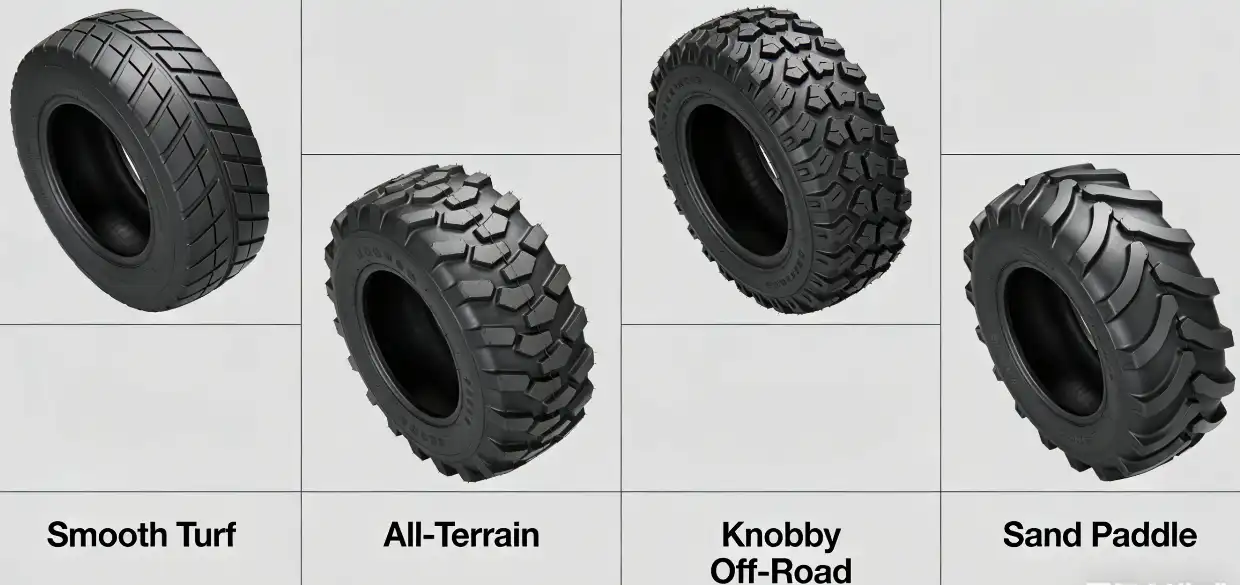
Turf/Street Treads: The Gentle Giants
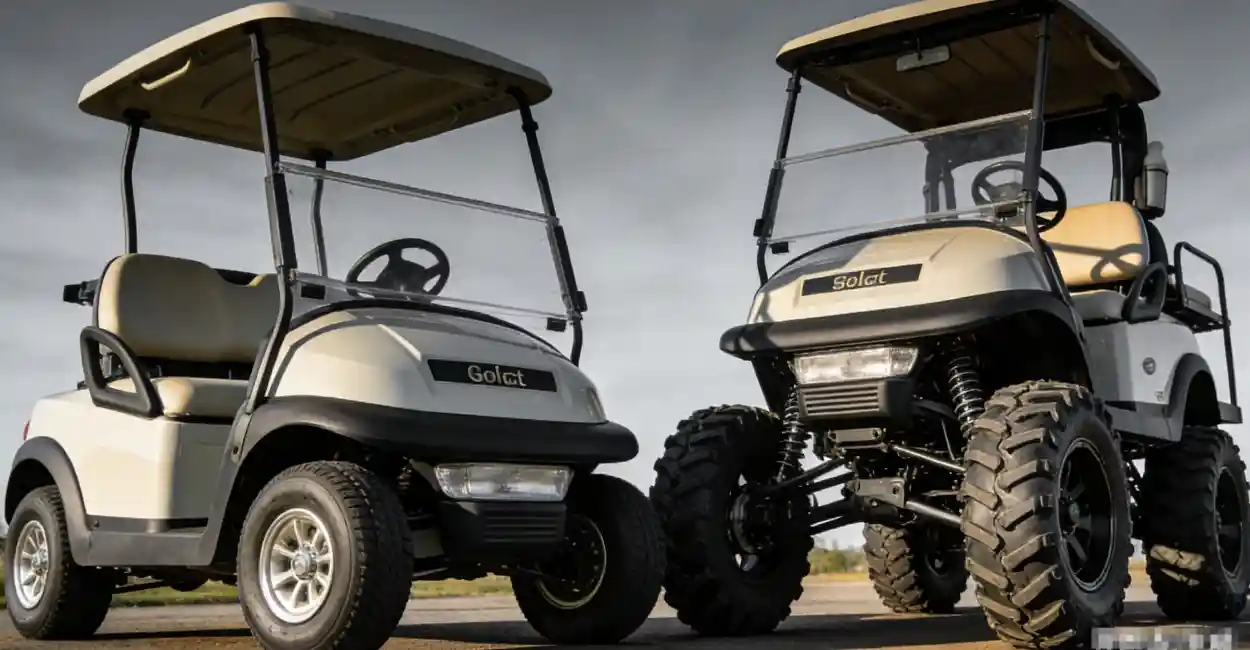
Most golf carts come equipped with Turf/Street Treads tires as default. These types of tires are designed specifically for golf carts so for purposes of riding on turf, while ensuring comfort on pavement as well. The tires are split into three categories.
Smooth and Straight Ribbed: The minimal rolling resistance of these tires guarantees a very gentle ride, both on pavement and grass.
Saw-tooth: The traction provided by this tread is common for many tires, and works well for golf carts as it is gentle enough to not damage the fairway.
All-Terrain Treads: The Versatile Voyager
All-terrain tires are the gentle balance required by a golf cart owned by someone who does not stay limited to the course and paved roads. The slice patterns on these tires are more aggressive than turf tires, and so can grip gravel and dirt on lighter off-roading. These tires work for someone who drives on carts off-road and on turf, while not requiring heavy puncturing of the ground.
Knobby/Off-Road Treads: The Trail Tamers
The tougher the terrain, the tougher the tire. These are the most aggressive type of tire that a golf cart can have. Designed to tackle the most unfavorable conditions, like deep slush, unstable sand, and rough, uneven ground, knobby tires work best. The aggressive construction of these tires helps them to dig and penetrate the surface, offering the traction needed to forge ahead. But like anything else, there are downsides. Knobby tires are a no-go for golf courses. Also, the shrill sounds and rough ride that these tires deliver on paved roads is unacceptable.
Sand Treads: The Dune Dancers
As an off-road tire option, sand tires are uniquely designed with "paddle" or indented patterns on them. These sand tires are designed to work on loose and shifting terrains like sand dunes or beaches, and where a typical knobby tire would fail with other tires and get stuck, sand tires would excel.
The Ply Rating : A Measure of Strength
A tire that a golf cart possesses has a ply rating or load rating. A rating like that tells you the amount of thickness there is on the rubber in that tire, and the amount of weight the tire can carry. It is something essential that any user should take on board, especially with a cart designed for assisting in heavy loads, or for the four-passenger model.



Send us an inquiry and our sales team will reply within one business day
Contact Us