Golf Cart Snow Tyres: The Essential Go-To Handbook for Year-Round Use

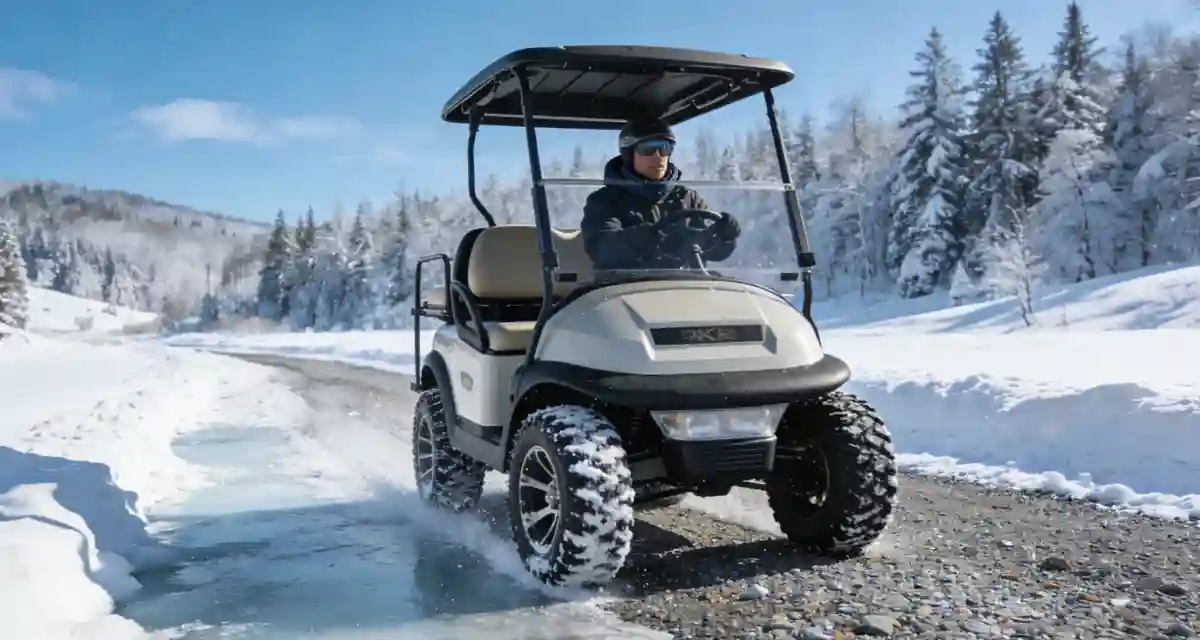
For a large portion of the nation, the start of the frostier months brings with it the first real snowfall and the start of a long, dormant season for many vehicles. One of the first vehicles that goes dormant during the first snowfall is the golf cart, which is left in the back of the garage, being charged until the spring comes. In which case, it forgets the season it is in. What if this didn't have to occur in the first place? What if your utility golf cart didn't have to be stored all winter, and instead, kept usable throughout the year? It is absolutely doable with the accessories and capabilities, in which case, are often overlooked. This is in regards to the golf cart snow tyres .
Contact Us: For personalized recommendations on golf cart snow tires , reach out to Global Excel Tyres . Email: info@excelindustryltd.com | Phone / Whatsapp : +86 15621053752 | Website: www.excelindustryltd.com
Our team of experts is ready to help you find the perfect winter tire solution for your golf cart needs.
No, this is not simply an issue of selecting a more aggressive tread pattern. True winter performance is a sophisticated scientific endeavor. The challenge lies in negating the effects of low temperatures, which cripples rubber, and frozen precipitation, which nullifies friction. An all-terrain tire is capable of a lot. However, the mud and gravel silt won’t save you from the perilous liability of slick, packed snow and treacherous ice. The set of tires forged for genuine winter mobility is different. They are built from the ground up to confront and conquer the unique frozen physics of your tires. The choice can profoundly redefine your vehicle, unleash its potential, and broaden its utility in the coldest months of the year.
This isn't a product page that highlights products alone, your all-inclusive, and a go-to guide concerning golf cart snow tires is a guide as comprehensive as ever. We will be moving further ahead and analyzing the science behind the winter traction . We will study the crucial differences in the winter-ready tread patterns. We will dive into the complex world and the studded tires that are often revolutionary and legally tangled. We will then provide an actionable and clear plan for your optimal winter set-up. This is conditioned by your requirements and the prevailing weather conditions. The mission is simple: ski, and worry not about winter conditions, with cover enough to provide unparalleled freedom.
The Physics of Cold - Why Your Summer Tires Fail and Winter Tires Prevail
The need to construct golf cart snow tires is apparent for all to see. The other world however doesnightly drags with it the effects of the winter – and that is the simple reason that is needed to understand why that need arises. July, for example, is the complete opposite of what it can be in the winter. We in July experience a completely different reality to other months. There in July, you experience a reality which is the result of the relationship that is formed and curbed by the tires and the rubber complex alongside the terrain. Winter wages a war that has two fronts against that relationship.
The Enemy Within: The Effect of Cold on Rubber Compounds
Tires are created through the intricate blending of synthetic rubbers, natural rubbers, various polymers, rubblack carbon, and more. The compound has been engineered to work within specific temperature boundaries. With a dip in temperature to and then below the freezing point of 32°F rubbers undergo a change in molecules. Within a typical "three-season" tire, polymers that could manifest change and wrap around contours become less flexible and more rigid with a dip in temperature. A soft and pliant tire at 75°F could undergo change in temperature and at 15°F be as firm as a puck. The amount of stiffness attained, also known as hardness or durometer, constitutes a change that has a radical influence on the amount of friction produced. The tire is unable to create a cohesive enough bond to allow for proper traction .
In contrast, a genuine golf cart snow tire is made with a different chemistry. It contains a high silica compound and other unique polymers specifically designed to remain soft and flexible at ultra-low temperatures. The tire remaining pliable at sub-zero temperatures is, without a doubt, the most critical and most unseen characteristic of a winter tire. It is this ‘softness’ that allows it to keep conforming to surfaces and developing vital mechanical grip long after a standard tire has given up.
Enemy From Outside: The Dangerous Domain of Snow and Ice
The second front of this battle is a treacherous one, the ground. Snow and other winter precipitation provides a surface that is downright hostile to friction.
Snow is something other than a single, homogenous substance. Its composition is highly variable. Another problem toward most snow is also something that is extremely variable and has some unique characteristics.
Deep, Fresh Powder: Under this condition, traction is to a large degree, a matter of ‘flotation’ and ‘propulsion’ rather than friction. The tire acts as a paddle and has to have deep and wide voids to churn through the powder and propel a cart without sinking and getting stuck.
Taking a look at packed snow, compacted snow that is driven upon is a low friction surface. It becomes packed slick and becomes smooth. In order for a tire to break through the layer of packed snow, the tire must have sharp, angular biting edges.
The Ice layer is the most challenging. Ice is a near frictionless surface for practical purposes. In other worlds, a typical rubber tire simply has nothing to hold on to. In addition, the pressure applied on the rubber by the tire can instantaneously through fracture, form a microscopic layer of water by a process called pressure-melting, which creates even more slickness on the surface. This is the point where it's about rubber grip where everything becomes more complex.
A snow tire built for a golf cart is made specifically for the above challenges. The snow tire tread is more than a design pattern; it is a battle system designed to conquer the worst of winter.
Deconstructing Designs of Snow Tires: A Taxonomy of Winter Traction
The golf cart snow tire is a category and not a single tire. There are different design philosophies which make the category tire. It is important to select the one which best suits the most common winter conditions.
Category 1: The first aggressive all terrain A/T tire - The All-Purpose Winter Champion
For A/T tire users living within regions of modest, moderate snow, a first class aggressive A/T tire will serve efficiently as a dual purpose, “ snow tire ” for all four seasons.
The Design: Think of the classic “blocky” tire. The design encompasses large, independent tread blocks that have been separated by deep, moderately wide voids. For winter use, look for a tire that has a high concentration of sipes , which are the small, thin, slits that cut through bigger tread blocks.
How it Works in Winter:
In Snow: The deep voids and blocky pattern gives excellent “paddle” action in fresh snow, and the thousands of sharp angular edges of the blocks and sipes provides a good grip on the packed snow.
On Cold Pavement: While not a true winter compound, the heavy siping gives the tire a remarkable advantage over a standard turf tire by incorporating special tread patterns and more biting edges for cold, dry, or damp pavement.
The Verdict: A heavily siped A/T tire is the perfect "do-it-all" sloution for the cart owner who faces a mix of conditions: plowed roads, snow moderate deep snow on their properties, and cold clear pavement. A superb compromise for those wishing for a single set of wheels and tires, and are wishing to use it for all four seasons.
Limitations: It's primary limitation is on pure ice. Far superior to a turf tire, it still relies on rubber friction, which is largely absent on an ice surface.
Category 2: The Dedicated "Snow and Ice" Tire - The Un-Studded Specialist
This is a bit of a deeper category, and is sometimes the case with tires that have a directional tread pattern specially made for the obstacles of winter.
The Design: These tires tend to have a “V” shaped or chevron style directional tread pattern. The tread consists of smaller, densely packed, and highly intricate blocks that are trodden with an incredibly high amount of sipes. The rubber is a very soft, high-silica compound , and winter-grade.


Send us an inquiry and our sales team will reply within one business day
Contact Us