MC Tires (Motorcycle Tires):The Ultimate Technical Authority

The Engineering Nexus of Safety and Vehicle MC Tire Dynamics : Establishing the Critical Nexus
This foundational chapter of the textbook aims to prove that the MC Tires (Motorcycle Tires) are, without question, the most important engineering element of any two-wheeled vehicle. This is to say that they are the only physical connection to the road. Unlike 4-wheeled vehicles, motorcycles rely wholly on the precise, dynamic contact patch of the tires to achieve complete directional change, apply braking force, and stabilize at lean. Any selection, installation, or maintenance of any MC tire, which is deemed ‘acceptable,’ is an unacceptable threat to rider safety and the designed performance capabilities of the machine. This work aims to go beyond mere product reviews that are all too common. We intend to present a scientific, empirical, and authoritative account of the material science , construction methodologies , and dynamics that govern the performance of MC Tires.
For technical consultation or engineering support from MC Tires, please contact us via:
Phone / Whatsapp : +86 15621053752
Email: info@excelindustryltd.com
Website : www.excelindustryltd.com
Each segment in the market for MC Tires—from hypersport and track-day use to heavy touring and adventure riding—is distinct enough to require bespoke tires with different structural, chemical, and geometric arrangements. We intend to provide the precise, professional, and strategical knowledge needed to address these details with blind focus to the different class systems of Load Index , Speed Rating , Dimensional Compatibility , and the force of temperature and wear of the compounds used. Knowledge is key to understanding the impact of the use of different MC tires, including the importance of multi-compound technology for the geometric curvature of the carcass (crown profile) of the tires and the effect it has on the handling, balance, and controlling of the motorcycle. This is the bedrock analysis that will provide the reader competencies to discern the purchases that will maximize the machines capability, it will make all the other benchmarks in relation to the use of two-wheeled vehicles look obsolete, which is arguably the primary rationale in writing this document.
To develop motorcycle tires engineers must design them to manage enormous kinetic energy, along with cornering forces, and degree thermal changes. The MC tire must maintain constant contact with the ground no matter the riding condition, including vertical and cornering. We discuss why safety and dynamic control is essential and the technology that enables this.
Fundamental Code: Absolute Dimensional and Structural Compatibility of MC Tires
MC tires start and end with dimensions, and the tire’s structural constraints of its balance tire code. Compromising the stability of the vehicle in boundary geometry is the result of deviations of the Original Equipment.
180/55ZR17 is a tire size designation that is broken down into groups.
Unit 1: 180 is the cross sectional width of the tire in mm. Also know the section’s height is equal to 55% of the width and must be greater than 10 mm. The tire is also classified as a performance of racing tire. 55 is the tires height width ratio that defines the tire aspect ratio. Z indicates the max design speed for the tire. The tire expectation is for Z speed in the vertical position. The tire must rotate at 1, 2, or 3 Z. R is for the radial tire. 17 is the rim/disk wheel outer diameter in inches.
Width of the tyre needs to be in the millimetres to be considered accurate. The number matters because of necessary clearance inside the swingarm and the fender. Errors in the width to be calculated should also consider the width of the rim to be used, because a tyre that is wider than a rim wider than the rim will cause damage to the crown shape of the tyre, which causes lose the profile of the lean angle.
The height of the sidewall as a percentage of the section width. The sidewall is stiffer and shorter in the case of a lower aspect ratio (50 and 55). This ratio provides superior lateral stability sidewalls which is required in sport riding. The other ratio is higher (80 and 90). This provides a taller sidewall which is ideal for damping the impacts and for comfort in riding touring.
The necessary size of the wheel in a correct fashion is 17 inches.
Construction Type (R/B/—)
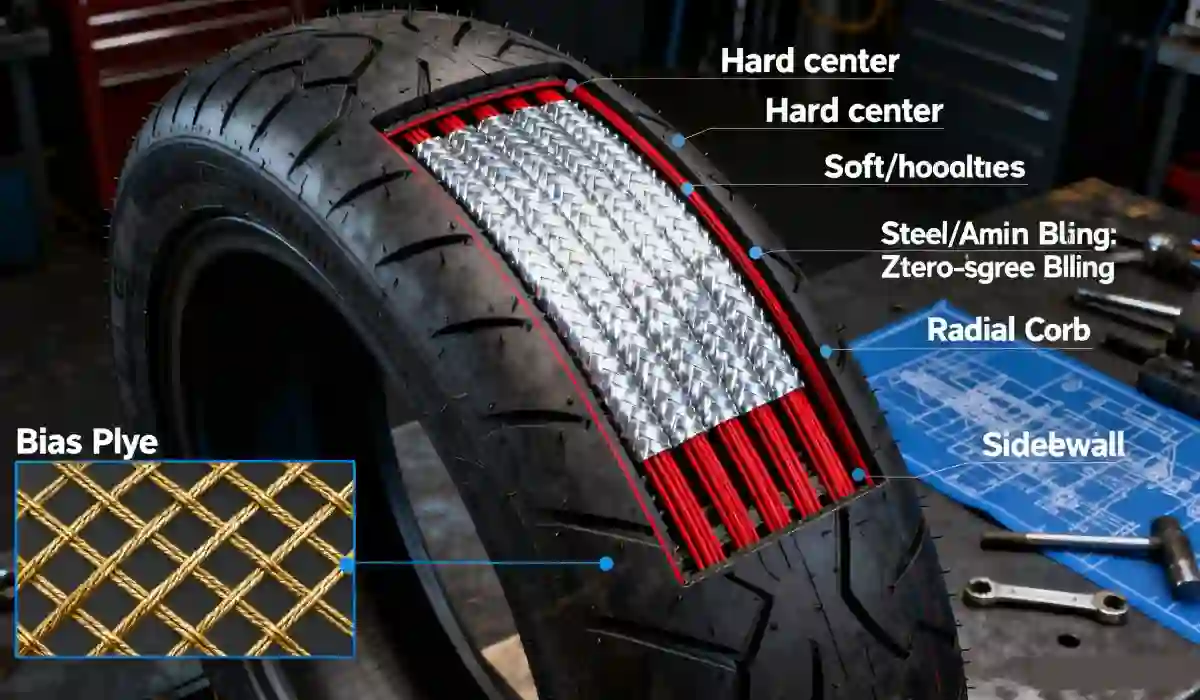
The construction letter R, represents the construction of Radial , while B indicates it is the construction of Bias Belt . The letter left blank can be considered as indicating it is construction of Bias Ply . Radial is the ‘high-end’ standard for modern cross country attitude and performance MC Tires.
Non-Negotiable and Irrefutable Structural Constraints: Load Index and Speed Rating
What Load Index and Speed Rating are stamped on the sidewall of the tire, are the most important safety limitations, which, at the bare minimum, should match the OE specs for the motorcycle, and not the other way around.
Load Index Rating (73)
Every tire has the maximum load it supports, and its bearing capacity in lbs (e.g., max load capacity – 805 lbs). It should not only bear the weight of the person riding it, but also a person sitting pillion and additional luggage. Failing to do so will lead to the tire overheating and simultaneously, suffering a grave structural collapse. It’s a blow out as a result of restrained casing overstressing that comes at a significant cost.
Every motorcycle has a maximum safe speed, e.g. 168 MPH (this has to do with thermal rating, as the tire should not collapse structurally with excess heat). It should be above and beyond the motorcycle’s top speed. The motorcycle maximum speed must be exceeded. This is a thermal rating which means that the tire should not collapse structurally with excess heat. The immensely grave scenario is done with – persistent high speeds lead to a thermal breakdown of the tire, which results in the breakdown of the tread.
Ano and minus, the Load Index and Speed Rating for all the MC Tires has to be above or equal to OE specs. The other will is selecting a tire with a depressed rating, is the highest gamble in terms of rider safety.
The Important Consequences of Crown Geometry on the Carcass Profile
The tire’s “crown” or the curve between the shoulders, is the most important factor that determines how a motorcycle is going to handle and lean.
Sharp/Pointed Sport Profile
More narrow and pointed shapes and angles which geometry reduces contact area on the outside ring when the motorcycle is inclined deeply enough at small lean angles. This allows the motorcycle to drop into the corner faster and requires less effort to steer.
Round/Flatter Touring Profile
Wider, rounder, and flatter for greater contact area while upright, which increases straight line stability and center tread wear life, the flatter profile improves longevity for high-mileage use.
We won’t change the brand or model of the tire without checking the front and back tire profile compatibility. A sharp front tire profile pointer mismatched with a round rear profile tire pointer would result in unpredictable and unstably steered erratic movements.



Send us an inquiry and our sales team will reply within one business day
Contact Us