50/50 Motorcycle Tires: The Definitive Guide to True Dual-Sport Freedom
In the expansive and exhilarating world of adventure motorcycling, the ultimate promise is one of boundless freedom. It is the dream of a single machine capable of devouring endless miles of smooth asphalt, only to seamlessly transition onto a gravel track that disappears over the horizon. It is the allure of the unknown path, the road less traveled, and the ability to say "yes" when the pavement ends. This dream, however, presents a profound engineering paradox: the qualities that make a motorcycle tire excel on the street are fundamentally opposed to those required for competence in the dirt. This is the challenge that gives rise to one of the most versatile and important categories in motorcycling: the 50/50 motorcycle tire .
These tires are the great enablers, the master compromisers, the very heart of the modern dual-sport and adventure bike. They are not merely tires; they are a declaration of intent. Choosing a 50/50 tire is a commitment to a style of riding that refuses to be limited by the surface beneath. It is a choice for the rider who demands the ultimate in versatility from their machine.
This guide serves as a definitive, deep-dive exploration into the world of 50/50 motorcycle tires . We will move beyond simple definitions to dissect the intricate anatomy of their design, from the science of their tread blocks to the chemistry of their rubber compounds. We will identify the ideal rider and machine for this category, manage performance expectations with uncompromising honesty, and provide a strategic framework for selecting and maintaining the perfect set for your adventures. Our mission is to equip you with an authoritative understanding, empowering you to unlock the true "go-anywhere" potential of your motorcycle.
For personalized tire selection advice or product inquiries, contact us at:
Email - info@excelindustryltd.com
Phone / Whatsapp - +86 15621053752
Website - www.excelindustryltd.com
Demystifying the Category: What Exactly Defines a 50/50 Motorcycle Tire?
The term "50/50" is a powerful and evocative descriptor, but it is not a rigid technical standard. Rather, it represents a philosophical position within the broad spectrum of dual-sport tires. A 50/50 motorcycle tire is one that has been meticulously engineered to provide a roughly equal balance of performance capabilities on paved surfaces and off-road terrain.
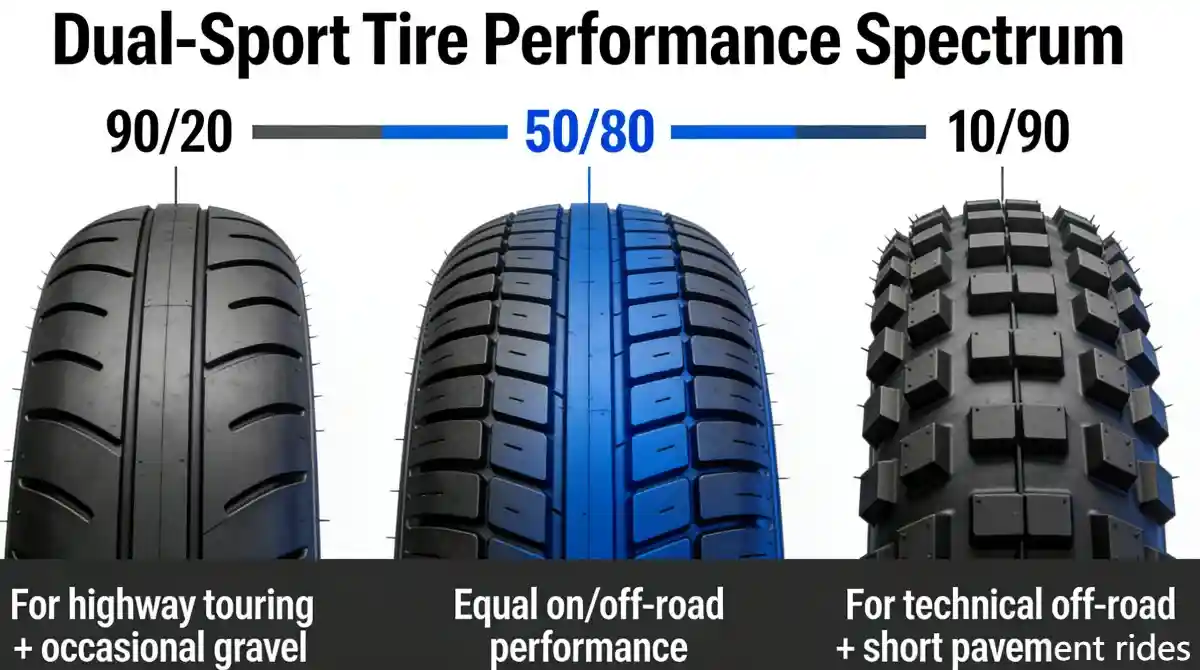
To truly understand this, we must visualize a sliding scale of dual-sport tires:
At one end (90/10): We find street-biased adventure tires . These feature minimal tread voids, continuous center ribs, and profiles that look very similar to a sport-touring tire. They are designed for 90% on-road use and 10% occasional use on graded gravel or hard-packed dirt roads.
At the opposite end (10/90): Here lie the aggressive, DOT-legal knobbies . These tires have massive, widely spaced tread blocks and are essentially dirt bike tires made with a compound durable enough for short-term road use. They are designed for 10% road use (getting to the trail) and 90% serious off-road terrain.
The 50/50 motorcycle tire resides squarely in the middle of this spectrum. It is the ultimate compromise, purpose-built to be reasonably proficient everywhere, without being a dedicated specialist anywhere. Visually, it is instantly recognizable. It eschews the smooth, continuous surfaces of a street tire in favor of large, independent tread blocks. However, these blocks are closer together and have more surface area than a full knobby, providing the stability and contact patch necessary for safe on-road operation. This deliberate balance is the result of a significant engineering challenge, requiring a sophisticated interplay of tread design , rubber compound , and internal construction .
The Anatomy of a 50/50 Tire: A Deep Dive into Design and Construction
The unique performance of a 50/50 motorcycle tire is not accidental. It is the result of specific, intentional design choices that balance the conflicting demands of pavement and dirt.
Tread Pattern: The Intricate Science of the Block
The tread pattern is the most visible and defining feature. It is a complex landscape of rubber designed to interact with surfaces ranging from smooth, hot asphalt to slick, wet mud.
Large, Independent Tread Blocks : This is the foundational element. Unlike the interconnected ribs of a street tire, large, distinct blocks are essential for off-road traction. They act like paddles, digging into loose surfaces such as dirt, gravel, and sand to provide forward drive and braking grip. The sharp leading and trailing edges of these blocks are what bite into the terrain.
Significant Void Ratio : The space between the tread blocks is known as the void ratio . A 50/50 tire has a significantly higher void ratio than a street tire. This space is critical for two reasons. First, it allows the tire to self-clean; as the wheel spins, centrifugal force flings mud and debris out of the voids, presenting a fresh biting edge for the next rotation. Second, it allows the blocks to penetrate soft surfaces to find purchase.
Tie-Bars and Block Stability : A key challenge with blocky tires on pavement is "squirm." At speed and under cornering forces, tall, independent blocks can flex and move, leading to a vague, unstable feeling. To combat this, engineers incorporate tie-bars —small rubber bridges that connect the blocks. These tie-bars add rigidity and stability to the tread area, dramatically reducing squirm, managing heat buildup, and promoting more even wear on the road.
Siping for Wet Traction : Within the large tread blocks, you will often find smaller cuts and slits known as sipes . These features are critical for wet pavement performance. As the tire rolls, the sipes open up, providing more biting edges and creating channels for water to escape from the contact patch, improving grip and resisting hydroplaning.
The Advanced Chemistry of Compromise: Rubber Compounds
The rubber compound of a 50/50 motorcycle tire is a minor miracle of chemical engineering. It must perform a seemingly impossible task: be soft enough to conform to and grip off-road obstacles like wet rocks and tree roots, yet be hard and durable enough to resist being shredded by thousands of miles of abrasive asphalt.
Modern 50/50 tires achieve this through the use of highly advanced, silica-rich compounds . Silica is a reinforcing filler that allows the rubber to remain flexible over a very wide temperature range. This flexibility is key to providing excellent mechanical grip in cold and wet conditions on the road. Simultaneously, these compounds are infused with other polymers and carbon black formulations that enhance tear resistance and durability, providing respectable mileage even under the high torque and weight of a large adventure bike.
Carcass Construction: The Foundation of Strength and Stability
Beneath the tread lies the tire's carcass —its skeleton. The construction of this carcass has a profound impact on the tire's overall performance. In the 50/50 category, we primarily see two types.
Bias-Ply Construction : The traditional method, bias-ply construction involves layering fabric cords (like nylon) in a crisscross pattern. This creates a single, tough, and integrated unit where the sidewall and tread are interdependent.
Strengths : Bias-ply tires are renowned for their incredibly tough and puncture-resistant sidewalls. This is a massive advantage in rocky off-road terrain. They also have a more flexible casing, which allows them to be "aired down" more effectively to increase the contact patch for technical off-road sections.
Best For : Smaller and mid-size dual-sports (e.g., Kawasaki KLR650, Suzuki DR-Z400, Honda CRF300L) where rugged simplicity and off-road durability are paramount.
Radial Construction : The more modern approach, radial construction features body plies that run straight across the tire from bead to bead, with a separate system of stabilizer belts under the tread. This allows the sidewall and tread to function more independently.


Send us an inquiry and our sales team will reply within one business day
Contact Us